THE PIONEERS

We have detailed events that opened our corner of the state for settlements in our first article of America 250 series. We must add, however, that the government could not sell land until it was surveyed. Most of our land was (and still is) sold on a square grid system that we are familiar with, but land adjoining navigable rivers, which were the primary transportation routes in our early history, were divided into long and narrow numbered tracts designed to give the maximum number of land buyers access to the waterway. Many of our early settlers, including John Pray, bought a numbered River Tract along the Maumee.
We must appreciate the courage and fortitude of our true pioneers. Imagine what it takes to leave a comfortable house and town where all comforts of goods and services are available and move to a wilderness with none of these comforts. The pioneer had to create his own shelter, clear land to grow food for family and necessary animals, and be able to subsist on the available natural resources. The nearest trading post or source of goods and services were 60 to 80 miles away through the wilderness. And yet they came, they stayed and built their own communities.
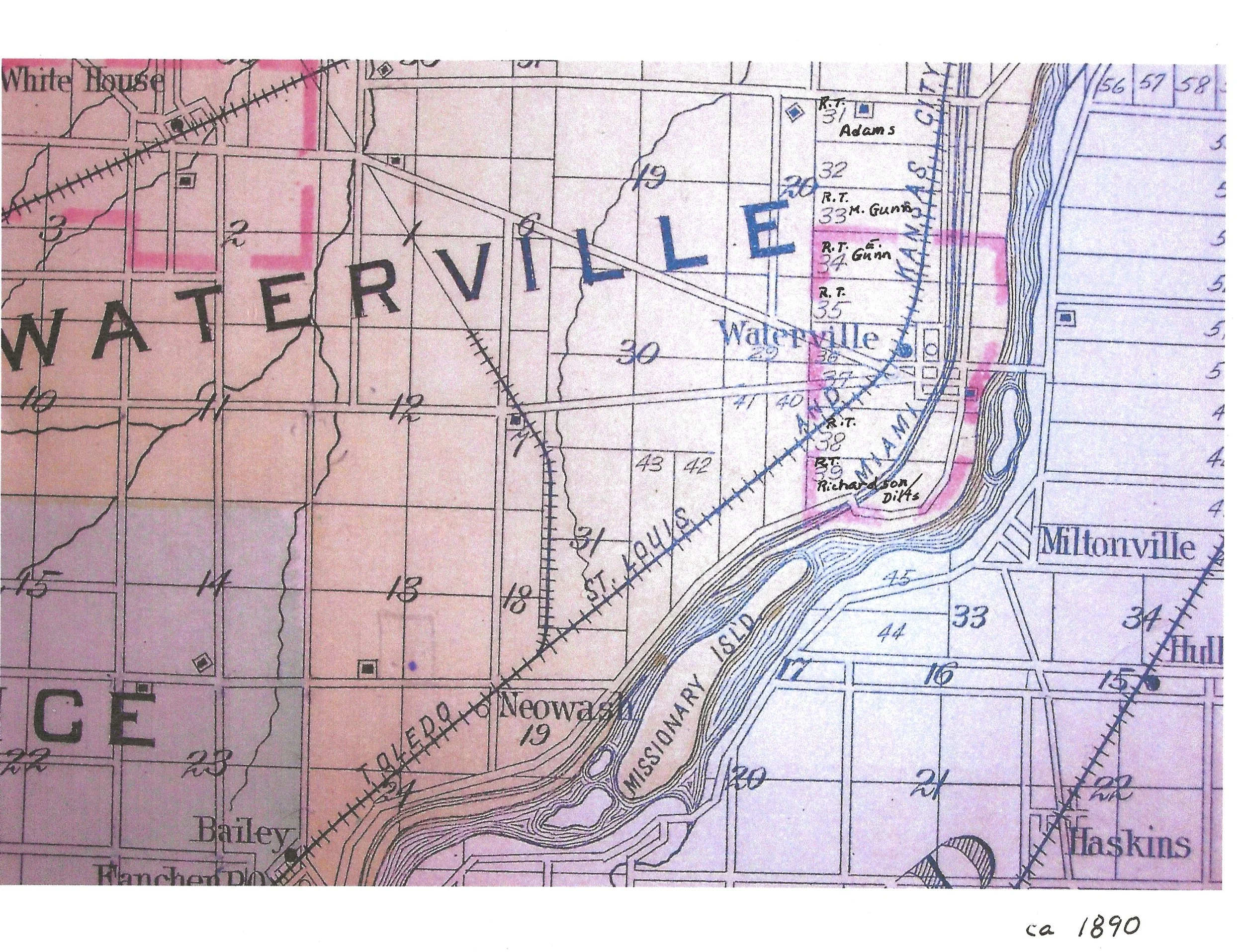
The first settler of record in this post war era was Isaac Richardson who, with wife Jane, built a double log cabin in 1814 next to the river trails and opposite Roche de Boeuf in R.T. 39. This land was owned by is father-in-law. He soon turned his cabin into a tavern and traded whisky to the Indians and travelers along the trail. Mr. Richardson by all accounts was a most unsavory character. He was shot in 1830 by George Porter, his hired man who he had cheated too many times.
Elijah Gunn came in 1815 and purchased River Tract 34 which later was the Liberty Haskins Farm. His brother Elisha Gunn and wife Mindwell Carver Gunn followed later in August 1818. The Gilbert Underwood family arrived in 1816. This family demonstrates the hardships of pioneer life. Five members of the Underwood family died of the “swamp fever” (Malaria) between arrival and 1820, Gilbert himself first August 7, 1819. The swamp fever affected many of our pioneers and they did not know what caused it. Also in 1816 James C. Adams with a party from Vermont explored the area and purchased R.T. 31 (bordering present day Dutch Road and the river) and built a group of cabins for family and friends that would move there in the next year. Six families, mostly Adams kinfolk, left Vermont for an overland trip to Ohio in ox carts loaded with all goods needed for their pioneer life and some livestock in tow. Two families sent exploratory parties through the area in 1817 with intent to settle in the area. Martin Gunn from Montague, Mass. explored the lower Maumee Valley and purchased land on R.T. 33. He returned in 1818 with a party of 13 people mostly family. John and James Pray with several friends from Smithfield, Madison Co., New York explored the valley, traveling from Detroit to Fort Defiance looking for an ideal place to start a “colony”. This party sent John back along their path to choose the best spot while the rest returned to New York. John Pray chose our area because he saw the flat fertile land and water power in the rapids to power a grist mill, a must for farmers to thrive. John returned to New York and prepared to sell his farm and bring his family to the Ohio wilderness. We shall continue the adventures of John Pray and the founding of a “colony” in the next episode in our series.
Author’s note: I have borrowed freely from Waterville Historian Midge Campbell’s book “Watervillore” for this article. If you have a copy read her chapter on “The Pioneers” for more detail and also “Tales of Betsey” for more on the Adams family and pioneer life. This book is available at the library and our archives to read. John Rose