THE CANAL ARRIVES
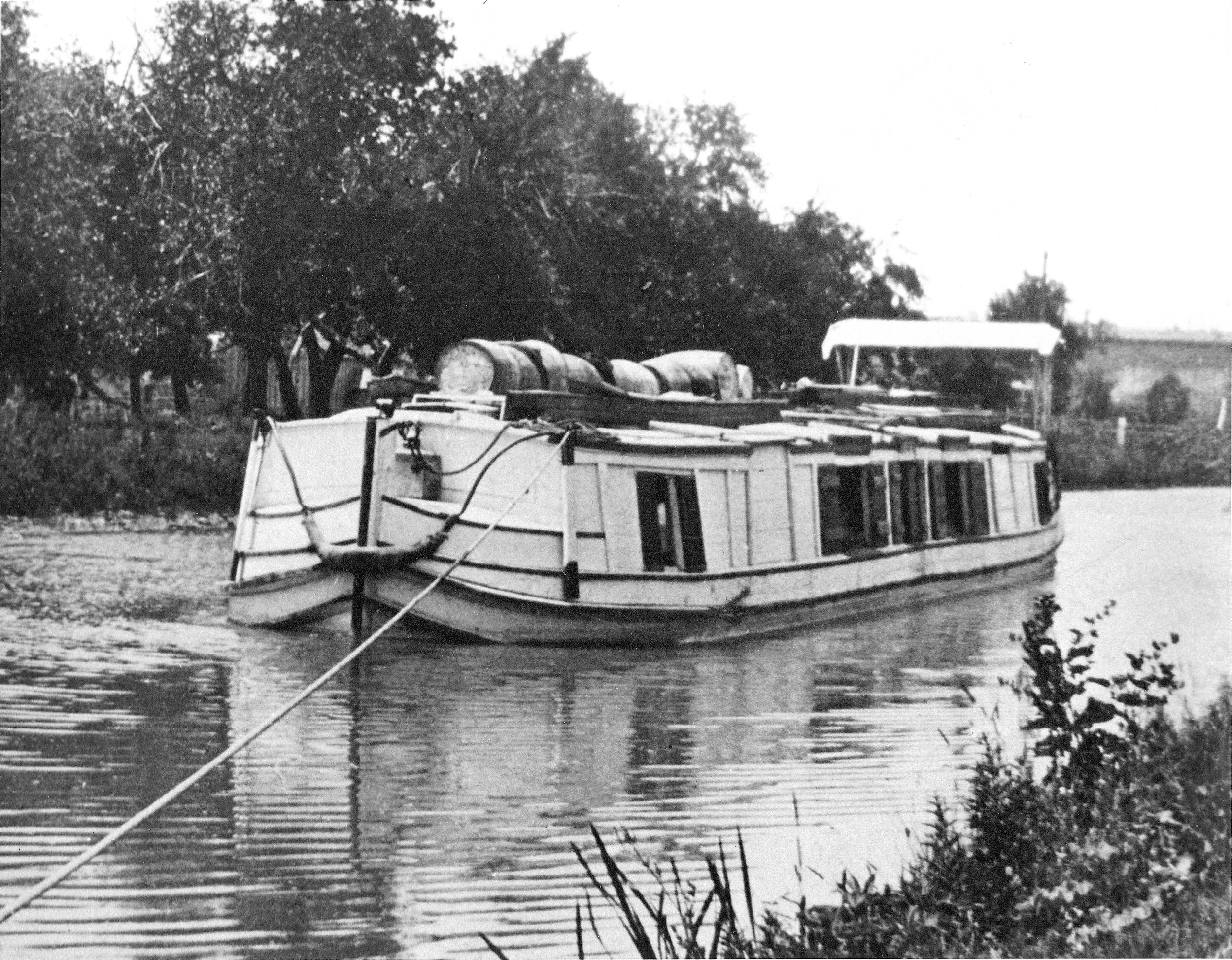
A canal Boat but NOT the ALBERT WHITE. No photography in 1843
As noted in our last Waterville year 250 article, the State of Ohio let contracts for the northern section of the Wabash and Erie Canal in 1837. The winning contractors immediately began to hire their workers and hundreds if not thousands of people looking for work descended upon the towns along the canal route. Many, maybe most, were immigrants recruited from aboard, especially from Ireland and Germany. So far so good – lots of workers to dig the canal. Then the bad. There was a severe financial panic in late 1837. The contractors had hired their workers and suddenly the State withheld their money to pay the workers. Now we had hundreds of people in Waterville Twp. with no income. Our trustees also panicked. In January 1838 they met and ordered Constable Lewis Eastwood to warn some 540 people who were not permanent residents to vacate the township. Eastwood was paid $53.37 for this duty and the name of each person served these papers is recorded in the Township Records, Vol. 1,
1831 to 1854 (see photo). Note: Early township records can be viewed at the Waterville Historical Society Wakeman Archives. This seems cruel, but feeding and caring for over 500 indigent people could have bankrupted the Township. Apparently most of these people did not leave, but survived the 3 or 4 months until the State freed up the money to put them to work, by neighbor helping neighbor. (A loaves and fishes story if you wish.) The record shows that Dr. Welcome Pray was paid by the township several times for medical services to an indigent.
Work on the canal resumed by late spring 1838 and progress then was rapid. The work was hard, the hours long and diseases rampant. Remember there were no mechanical devices in 1838. It was pick and shovel work for the entire canal. A horse drawn scoop was the best we could do for technology. Besides their meager pay, the men were given two “jiggers” of whisky per day (large cup) which may have made the work lighter, probably made a good Irishman more argumentative and addicted some. I think they thought (incorrectly) that the whisky would ward off diseases. Many workers died digging this canal, usually of disease or accident. It has been suggested that the small section of our Wakeman Cemetery with few stones was a “potters field” for unknown canal workers. We should also note that they were not just digging a big ditch. There were very strict specifications for the canal. The width at bottom and top, the slope of bank and the amount of drop per mile were all requirements the contractor had to meet. This probably kept the project engineer very busy.
The level section of the canal from Providence to Toledo was probably open by some time in 1839 or 1840 but the opening of the entire length of the Wabash and Erie Canal was celebrated on May 8, 1843 when the canal boat Albert White passed through Waterville on her way to Toledo from LaFayette, Indiana, where she was met with great fanfare. Our town was now open to Eastern markets via Lake Erie and the Erie canal to New York City and Southern Markets via the Wabash to the Ohio River to New Orleans. Also, through these seaports, open to world markets. A great period of prosperity would follow this event.
We would like to discuss some of the changes to our area due to the canals (plural since the Miami and Erie leg to Cincinnati opened two years later in 1845) in our next 250 article. We would also suggest historian June Huffman’s book “Olde Waterville” published in 1994, as a good read on this and many other Waterville topics (canals, p.10 in my copy). Signed, Author, John Rose
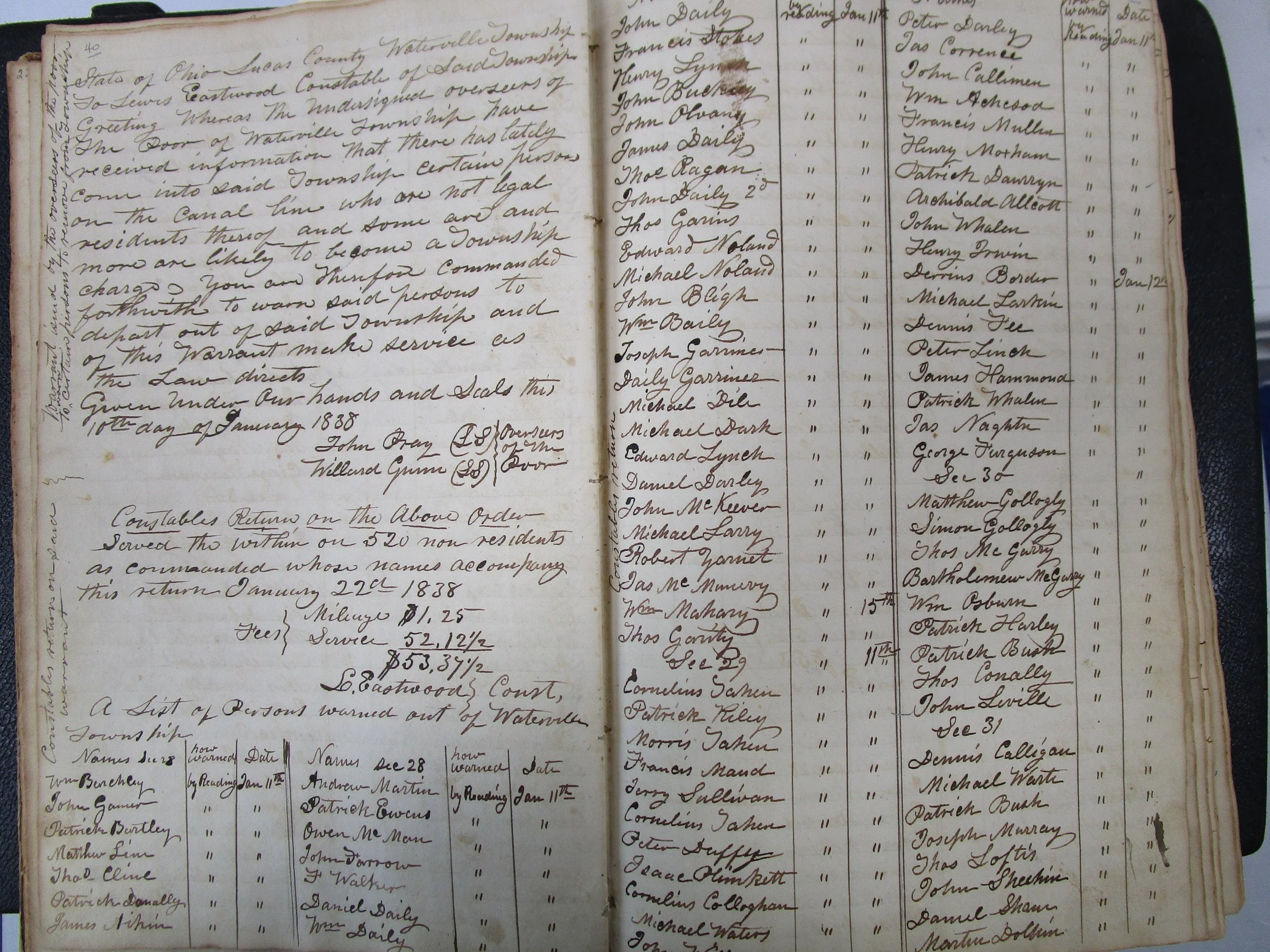
Waterville Township Record, Vol. 1, seen at the Wakeman Archives, 401 Farnsworth Road, Waterville, Ohio