Waterville Historical Society

your connection to the past

The Waterville Historical Society collects, preserves, provides access to, interprets and fosters an appreciation of history that has an impact on the Waterville, Ohio and surrounding area.

THE BIRTH OF ANTHONY WAYNE SCHOOL
In 1950 the local school districts of Waterville, Whitehouse and Monclova were all facing the same problem. Their student population was rapidly increasing and the existing building were overcrowded. They each needed to go to there voters asking for money to build new buildings. There were progressive thinkers in each community who realized that much duplication of effort and savings could be realized if they combined their efforts as a combined district to build one new high school building. The idea of consolidation was born. It was a hard sell but common sense prevailed.

The local school boards of Whitehouse, Waterville and Monclova each had to request from Lucas County Board of Education to consolidate their schools district with the other. Then on July 6, 1950 the new Board of Whitehouse, Waterville and Monclova took office.

On November 7, 1950 Monclova, Waterville and Whitehouse went to the polls to vote for a Proposed Consolation of the three schools into one high school building and a bond issue for a new high school building. The building was to be located on a rural area within reasonable proximity to the three towns.  The issue passed and land was bought with 20 acres from Sam Studer and 15 ½ acres from Daniel Studer on Finzel Road south of Weckerly and north of Rupp Road for a total of 35 1/2 acres.

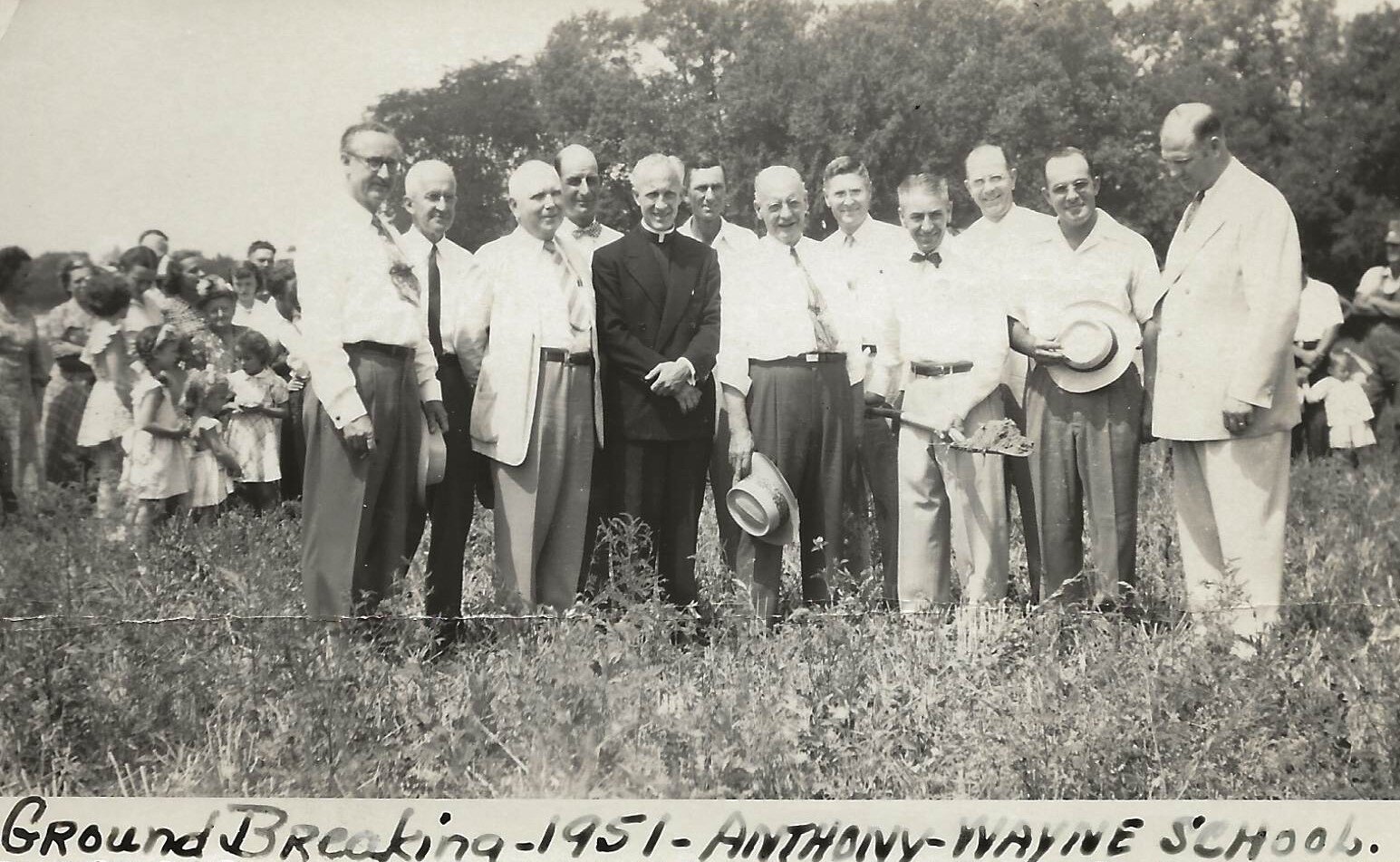
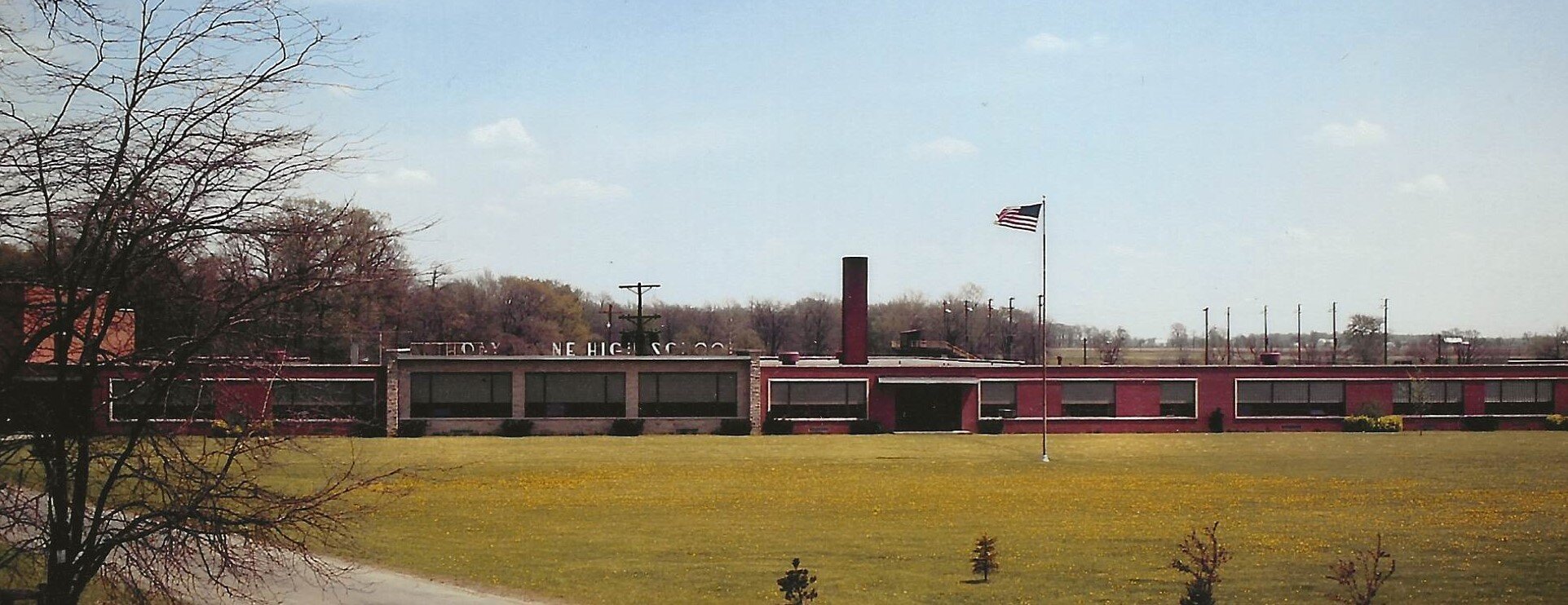
Ground was broken on August 14, 1951 and building was accepted for occupancy on December 24, 1952. Also in 1952, the Neapolis School District decided to become part of the Anthony Wayne system as before that time they paid tuition to attend Whitehouse. On January 19, 1953, it was the big moving day to move things from the other schools to the new high school. On April 19, the new Anthony Wayne High School was dedicated.  Even though we were not in the new school, the first commencement was held in the Whitehouse Football Stadium on May 25, 1951 and the following year the graduation was held in the Whitehouse Auditorium on May 23, 1952. At the time of the dedication of the school the enrollment was 375 pupils but the school was designed for a capacity of 600-650 students. I doubt former students would recognize the new building that stands today that has a student enrollment of  1358 in grade 9-12 and claims to be the 90th largest public high school in Ohio.

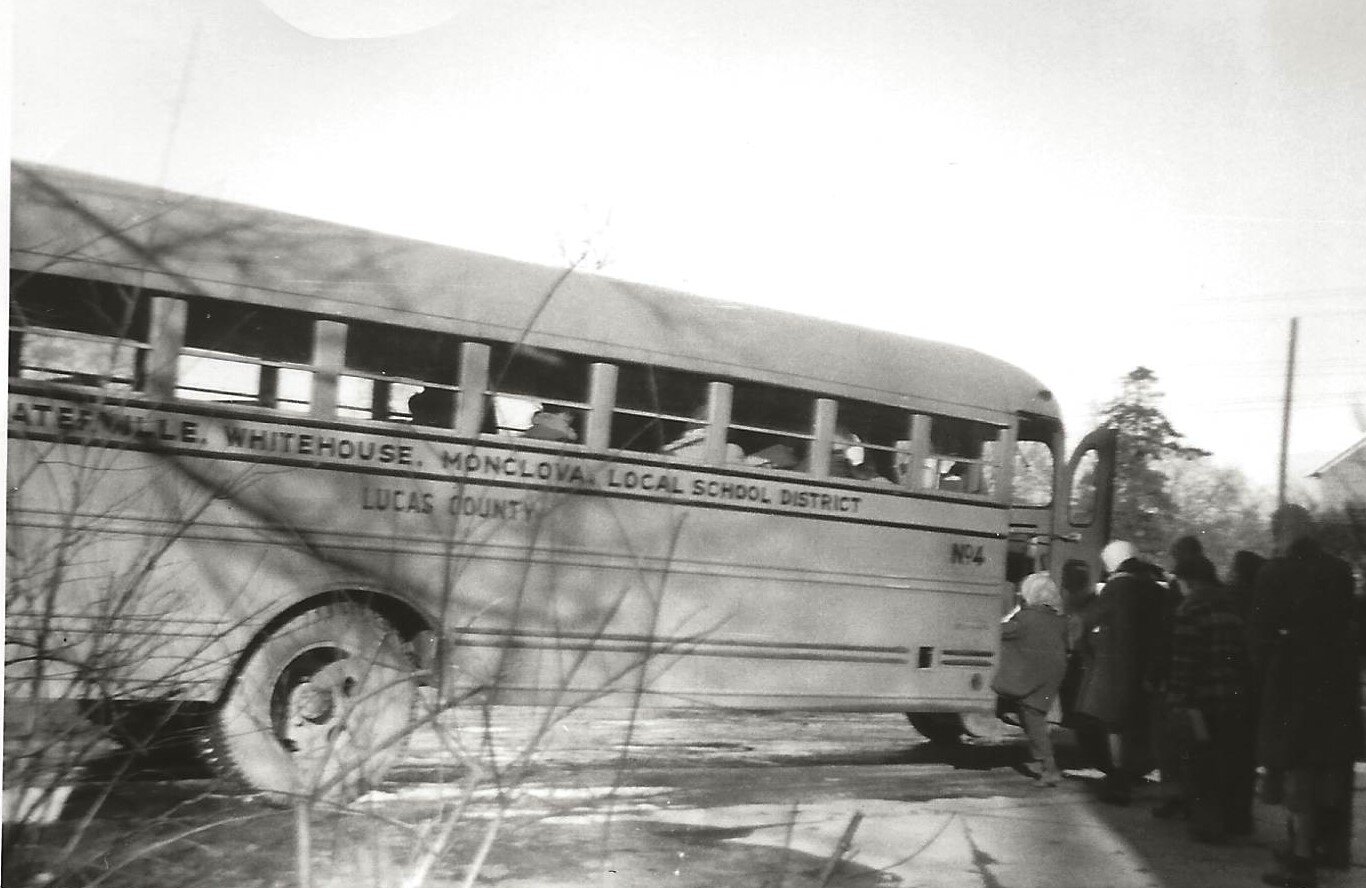
Originally the school buses had on the side of the bus “Waterville, Whitehouse, Monclova Local School District” but later the name was changed on the buses to the “Anthony Wayne School District.” They felt this name was appropriate. The school board had appointed a committee of three women: Mrs. Thelma Hammon, Mrs. Margaret Van Gundy and Mrs. Nellie Thomas and names were submitted by the public. They felt that the name Anthony Wayne was widely accepted and was appropriate with the Anthony Wayne Trail passing through the district and the Anthony Wayne Memorial nearby. It was approved the day before the election to build the school and the mascot name “Generals” followed naturally.

The new high school colors were decided to be blue and white but the school colors would remain the same for the three community schools. The colors were chosen since they were the colors worn by the Anthony Wayne Legionnaires.

Note: An interesting piece of history is that the Adams Twp. Freshman and Sophomores came to Anthony Wayne High school during the 1955 and 1956 school years. They transferred back to their new Rogers High School for the 1957 school year as juniors. Adams Twp. had to pay tuition to send their students to other schools until their new high school was built.

From the December 6, 1978 AW Herald it list the men in the picture from left to right: Howard Manor, Superintendent Dudrow, Senator Cramer, Willard Schaller, Rev. Buehler, member of AW Board of Education, H.E. Ryder, county superintendent, John Rudolph, Bob Shelton, Mr. Grimm Clerk, Rodney Boyer, and “R.W.”
CITIZEN TELEPHONE COMPANY

Have you ever been annoyed by your cell phone being out of power or not finding a tower? Think of your great grandmother who had no phone at all. The late 1800s invention that allowed voice communication over a wire was an amazing technological marvel, one of several advances that made dramatic changes to the lives of all Americans at the beginning of the 20th Century.

Here in Waterville telephone service arrived with the new century. Delmar Farnsworth, a brother of W.W. and W.G. Farnsworth, the orchard Farnsworths, had become fascinated with the telephone since his childhood days of tin can and string. He started his own telephone company in 1900 in the hardware store building on Third Street that he owned since 1893. (The building was in the same location that now houses Waterville Hardware. The original hardware building burned down February 1, 1955) His labor force consisted of Fred Murray and Floyd Bennett who set poles, strung the wire and installed the telephone. They also were switch board operators. This business operated 24 hours of the day, so by 1901 Lilly Fredericks Lederer was hired as the day operator. This was a 12 hour shift.  In 1901 there were all of 25 telephones in the village. Two years later there were 300 telephones and growing. The list of operators manning the switch board also grew, relieving the work crew to try to keep up with this rapidly expanding system. These ladies were  Emma Eastwood, Leah Murray, Leah Conrad and Ruth Bennett. The monthly rate for a telephone was $1.00. Just for comparison a 1900 dollar would equal about $32 today. A toll call to Toledo was 10 cents for three minutes.

The home or business telephone was a box on the wall and a turn of the crank would signal the central operator who would talk with you and perhaps exchange some choice gossip then connect you to the person you wanted to call. When the operator would ring a particular phone all phones on that line would ring so others could choose to “listen in” or even join the conversation. Of course telephone technology advanced rapidly and “central” eventually became automated. The telephone company soon moved to a new building around the corner on Mechanic Street with the Post Office downstairs and the Telephone Company and “Central” upstairs. This was probably in 1903 since that year William Witte, who now owned the hardware store, expanded his building by using steel from a washed out section of the 1881 bridge to add a second story. This became Witte’s Hall, which is another story. In 1907 Mr. Farnsworth took his growing company public. He sold stock shares to farmers, expanding phone service to rural areas. The newly formed company was called Citizens Telephone Company, which it would remain for many years as the Waterville and area telephone company. The cost for a 12 party line in the country was $2.50 per month to offset the cost of placing and maintaining miles of posts and wire and yet the miracle of voice communication was worth the expense to village and rural residents alike. As always, technological advances improved telephone systems. In 1941 the Citizens Telephone Co. built a new building on the west side of Second Street between Mechanic and North to house new automated switching equipment and updated its lines and all telephone equipment. Operators were only needed for long distance assistance. “Central” was replaced by rotary dial phones (anybody remember those?)

Delmar Farnsworth died in 1925 at age 51 but the company he founded lived on for many years. In 1960 a new telephone office to serve the public was built at 207 N. Second St., just a block north of the old Citizens Telephone automated switching building. The new office even had a drive-up window. Eleanor Wittes, according to the 1964-1965 AW Directory was a cashier there. Many other local people worked for Citizen Telephone over the years. Eventually like many corporations, mergers and buyouts swallowed up the small local company and became part of a multistate operation.  The building on 2nd Street is still there but is no longer a public building. It still houses switching equipment and maintenance for Century Link, which became Lumen Technologies, a local wired telephone service just last year.

Today, in the digital age, all of this is obsolete. Your phone is in your pocket, wireless and does far more than allow you to talk to someone not at your location. However for you folks who wish to rebel against all technology, the tin can and string telephone still works.

THE FIBERGLASS CITY?

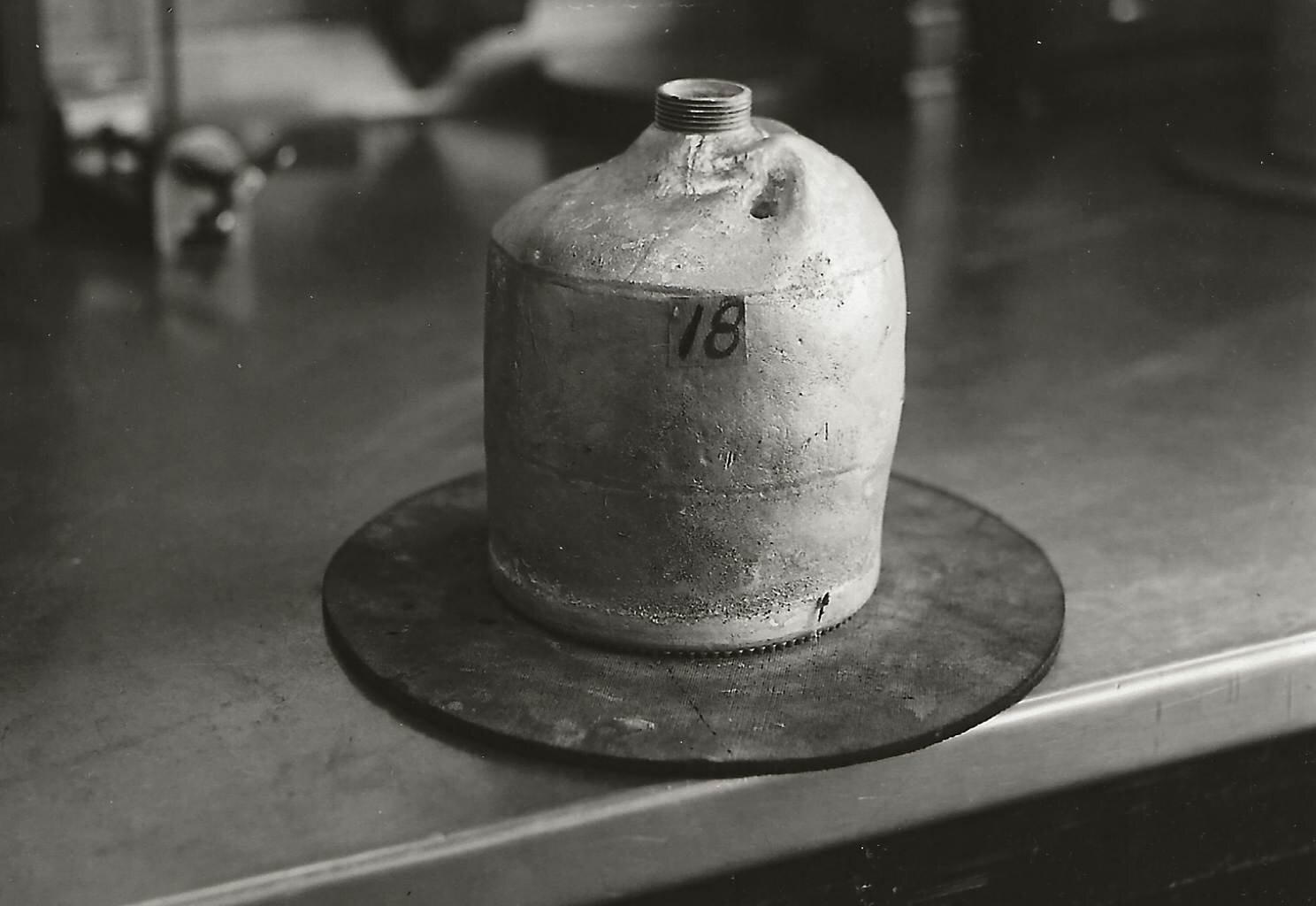
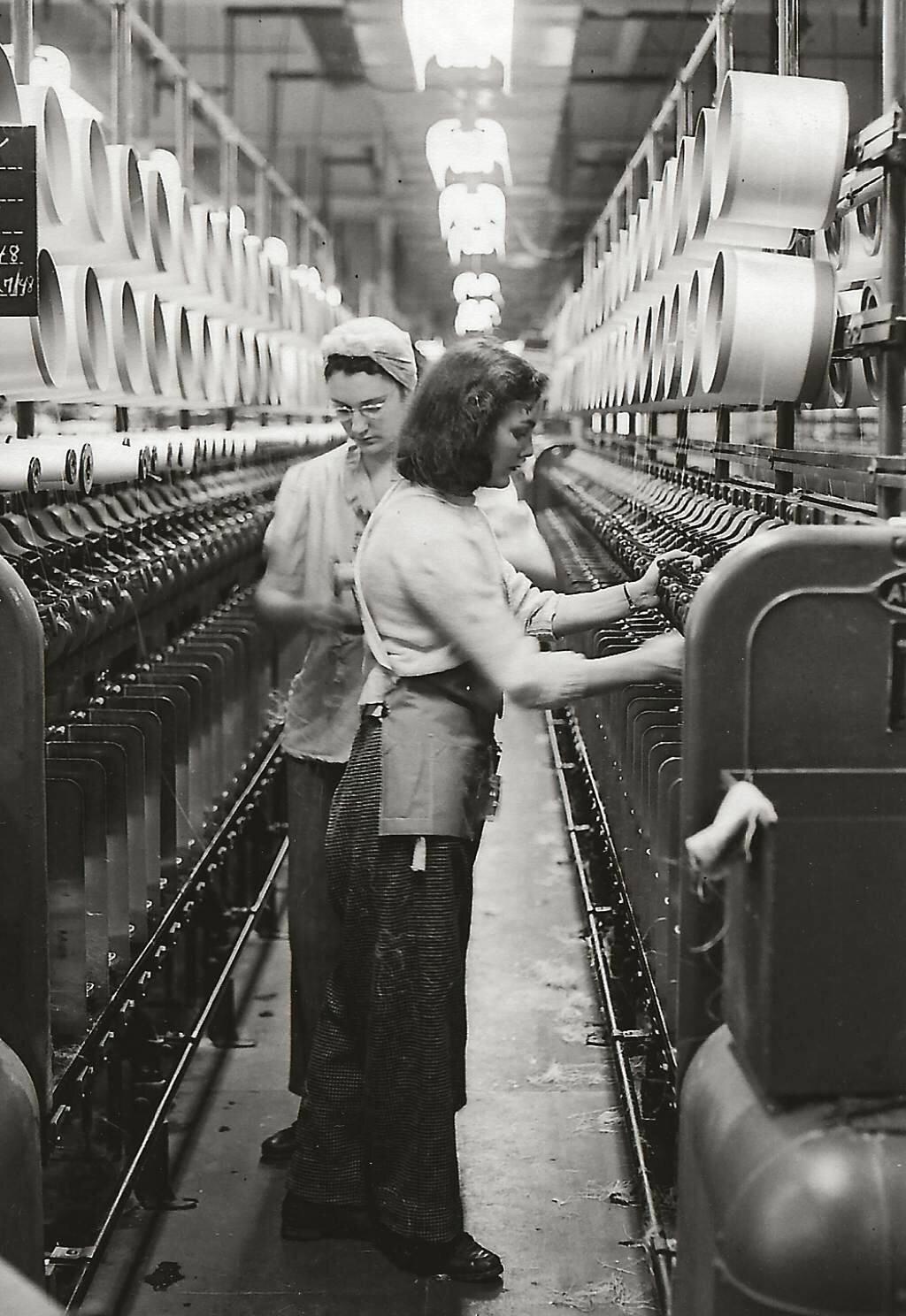
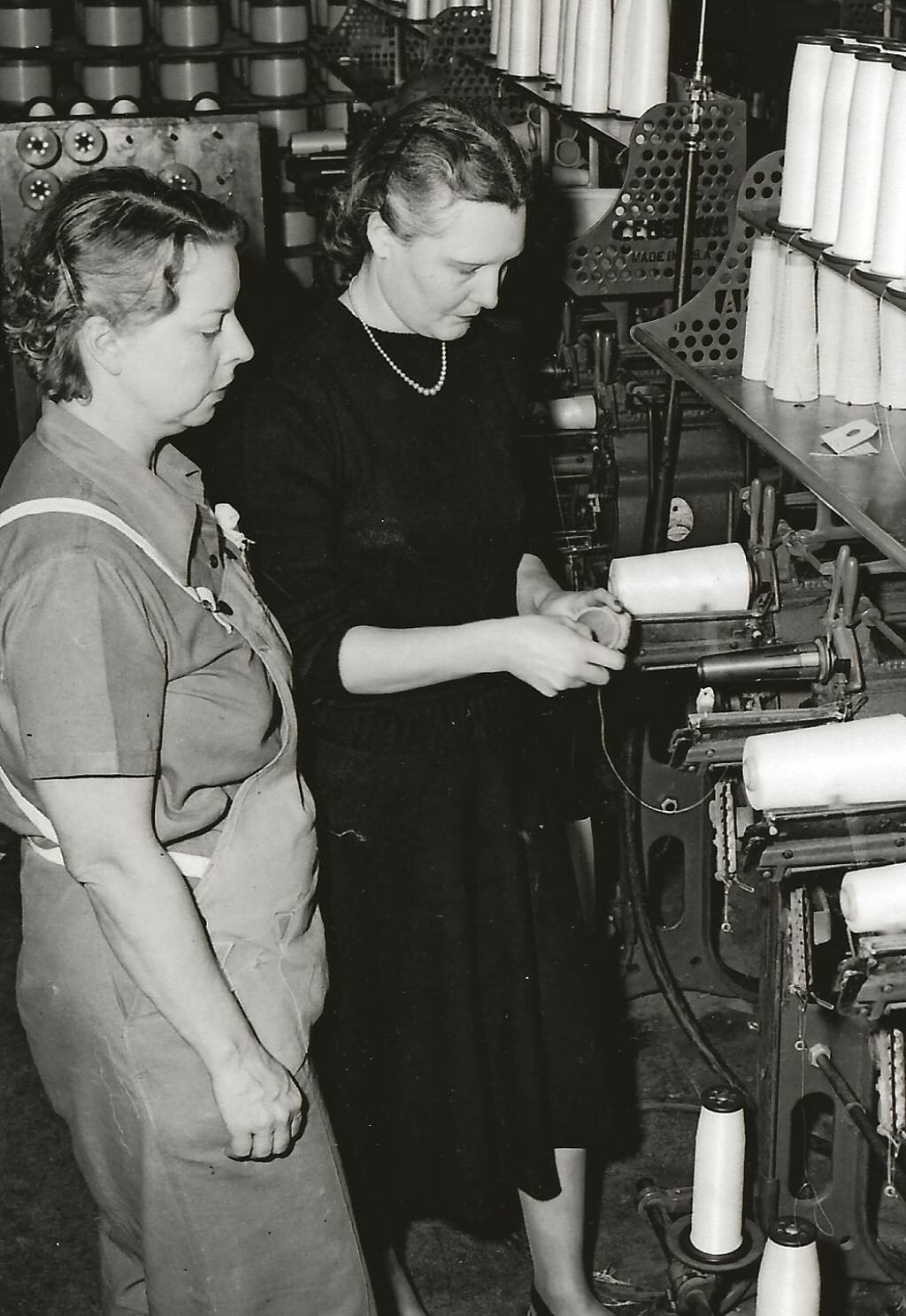
We might be. The production and commercialization of glass fibers began right here in Waterville. The idea of producing a flexible fiber from glass began with Owen Illinois Glass Company as early as 1931. During the next 10+ years, the manufacture of glass fibers was limited to rather short, coarse strands suitable for insulation, but unsuitable for the manufacture of glass cloth which required very thin fibers of unlimited length. I suppose WWII got in the way, but in 1944 Randolph H. Barnard, Dominick Labino and several others separated themselves from the Owen-Illinois Corp. to pursue the commercial production of glass fibers. They formed a corporation called Glass Fibers, Inc. with Barnard as President, several other ex-O-I people as corporate officers and one or more New York investors. Labino was the technical man. He was a well-known glass researcher with many patents, experimenting with glass formulas and production methods and he became Director of Research. A research facility operated in Toledo to perfect the process and design equipment to produce ultra-thin fibers from glass. By 1946 they were ready to go into production. A modest, modern building was built just north of Waterville at River Road and Stitt Road. The building was complete in February of 1946 and machinery, much of which was custom designed and built, installed by June. As production began, many local people were employed at this plant which was running three shifts, seven days a week. One hundred people were employed in 1946 with plans to expand to a least 150. A list of those employees, with address and hire date, is held in the Wakeman Archives.

The process involved making small batches of molten glass by melting a Labino formula of easily melted glass marbles in a platinum pot and forcing small threads of glass through holes in the pot. These threads are then stretched into a very small diameter filaments which can be twisted into a yarn of the desired diameter. These glass marbles are the raw material for fiber glass yarn and insulation to this day. This flexible glass fiber is known as “E-glass” and differs in chemical composition and manufacturing process from the fiberglass insulation produced for home insulation.

The Waterville plant only produced and sold glass yarn to manufacturers of a great variety of materials. It could be woven into electrical and pipe insulation, mixed with other fibers to form non-flammable material and was (and is) bonded with plastic resins to make anything from boats to car parts and many other uses.

Glass Fibers, Inc. later merged with a division of Libbey-Owens-Ford to form L.O.F. Glass Fibers that was sold in 1958 to Johns Manville, a worldwide corporation, who expanded fiberglass production and products around the globe. Dominick Labino stayed on as Vice President and Director of Research until retirement in 1965. He would continue as consultant another ten years. The local factory was expanded and continues to employ many local folks. In 1971 Johns Manville built a new headquarters building on Dutch Road along with an expanded research center. Today, that location also has a production facility.

One of the products produced only here in the Waterville facility and a direct result of Dominick Labino’s research are the insulating tiles, made from ultra-thin light weight silica fibers, used in the Gemini and Apollo spacecraft and the space shuttle reusable spacecraft to protect them from the searing heat of re-entry.

Dominick Labino is well-known and remembered in this community more for his work in starting and promoting the art glass movement than for his many patents and innovations in the glass and fiberglass industry. Many local people treasure their Labino glass art object. Labino died at age 76 at his Grand Rapids, Ohio home on January 10, 1987, and is buried in St.Patrick’s Cemetery in Grand Rapids.

Note: The photographs for this article were taken by Dorrance Talbut for the Standard newspaper in 1948. We would like to thank Gary Franks for his help with this article.

BRIDGE UP FOR AUCTION

Wanna buy a bridge? Seriously! The landmark Roche de Boeuf (Interurban) Bridge is being offered for sale by O.D.O.T. It is a little battered and run down but could be purchased really cheap. The notice was in last week’s Mirror newspaper in case you missed it, but the original notice was released last January. The notice says that O.D.O.T will offer by public auction certain tracts of excess land located in Wood and Lucas County on Wednesday, June 30, 2021 at 10:00 AM at the Maumee Rotary Pavilion at Side Cut Metropark, 1025 W. River Road, Maumee, Ohio. The pavilion opens at 9AM. The terms of sale and formal description of the property can be viewed in the Mirror or on the ODOT website: www.transportation.ohio.gov. If unable to find it here just google “Roche de Boeuf Bridge for sale”. PLEASE read all of the details in the documents. The owner assumes all responsibility for all aspects of the property. Oh yes, remember that if no one buy the bridge O.D.O.T. will have it demolished.

REMEMBERING MEMORIAL DAY

Memorial Day is a time to remember our veterans of all wars. The Boy Scouts have placed flags on the graves of the deceased veterans in the local cemeteries. Ceremonies will be held and patriotic speeches made. It is also a time we remember our deceased loved ones. Our cemeteries will be decorated with flags and flowers throughout.

At one time the Waterville American Legion Post would meet at the Legion Hall on Mechanic Street, line up with flag and military men in front, followed by the Waterville American Legion and the American Legion Auxiliary, Boys Scouts and sometimes decorated bikes. They would stop at the Waterville bridge where two junior girls would throw a wreath in the river to remember those that died at sea. The Anthony Wayne  High School Band would be marching with people along the route cheering as they played. Everyone would follow the parade up Farnsworth Road to the cemetery where speeches and band music would be heard near the statue in front of the cemetery. Later as the men and women were unable to march up the hill they started meeting at the Stitt Park and walking to the cemetery from there.

On May 31 at 11:00 AM we all will meet at the Veterans Memorial in the Wakeman Cemetery at 621 Farnsworth Road where Whitehouse American Legion is in charge of the services at both Whitehouse and Waterville. The Waterville American Legion has disbanded due to becoming a small group. It makes you feel proud when the Anthony Wayne Marching Band comes marching down the driveway. Boy Scout Troop 101 will be included in the ceremony. Arnie Elton U.S. Army Veteran who served in the Vietnam War will be the speaker. The traditional ceremony to honor the dead will be held. Hope to see all of you there!

Reflections on Literacy


A clear plastic bin given to me by my sister was full of items saved out by my mother in the last few months of her life. I found family pictures, a Hill, Hook, Clay, Good, and Tingley family tree completed by Howard Good, my grandfather, three Anthony Wayne Standards highlighting Harry Dudrow, the Assistant Superintendent of Anthony Wayne Local Schools, and an article reporting that Mom, Marian Good Morris, was starring in a musical at Waterville High School with her friend and classmate, Virgil Hannifan. I sorted through; there was more. Mom saved compelling legacy. Yet one more of my grandfather’s journals listing many of the books he read between 1965 and his death in November of 1967 was a revelation; I also found a newspaper photograph of Lois Waffle, longtime librarian and manager of the Waterville Branch of the Lucas County Library. My mama and Lois were Waterville High School schoolmates and fast friends.

Granddad favored biographies and autobiographies; Peter Marshall, Samuel Clemens, the Von Trappe Family, Charles Dickens, Jesse Stuart, Tallulah Bankhead, Dwight D. Eisenhower and more. He loved movies on the television, too, and kept a list with dates of those he watched on television. He watched For Whom the Bell Tolls with Gary Cooper and Ingrid Bergman (maybe twice?—he has two dates, March 17 and March 18, 1964). The list of movies is nearly as long as the list of books (I lost count of books at 26 somewhere in the middle of 1966.) Of course, Granddad wrote his memoir, Black Swamp Farm during these years. He was thinking about reading and writing and quality art. Certainly, I was predisposed to be a reader because of my genetics and family influence, but I had some wonderful reading mentors and experiences that cemented my love of story and the printed word, cemented my life choices of reading, teaching, and finally writing. Growing up in Waterville promoted our literacy.

Librarian Lois Waffle is part of my earliest and longest memories of becoming a reader and living life as a reader. For a time the branch library was on the first floor of the now torn-down Waterville Elementary School. I remember sitting on the yellow oak floor, listening to Miss Waffle’s colorfully beaded bracelets clacking together as she read and sold us story after story. She was a wonderful oral reader, expressive and dramatic. As a small child, I was mesmerized. Later, a new branch library was built above the hill across the railroad tracks. Instead of the polished yellow oak floor, we sat on a smooth white-tiled floor, listening still to the stories Lois read to us. I remember hearing the fancy blower of the air conditioner.

The new library meant a longer walk, crossing the Anthony Wayne Trail either on foot or when I was older on a bicycle. Lois still found new books for me, understanding the veracity with which I read them. For a time in third grade, she wanted me to read “Mrs. Piggy-Wiggle” books. I’m sure I did. She wanted me to try The Borrowers. I loved them. Like my grandfather, I loved biographies and read myself through the children’s biography section. Varina Davis, Emily Dickinson, Lucretia Mott, Girl of Old Nantucket. I loved all the biographies and autobiographies. I graduated myself to the adult section. I’m sure Lois knew, but she never told me I was limited in my reading choices.

I had wonderful teachers, too, who sold us books by reading aloud to us. Two that I remember were my third grade teacher, Miss Rashley, who read us E.B. White’s Charlottes Web. After lunch, every day, we couldn’t wait for the next installment of the Wilbur and Charlotte’s reading adventures. We acted out what are now called Reader’s Theater, plays based on books that we were reading—Tom Sawyer, Sleeping Beauty. In sixth grade, Mrs. Euler introduced us to Victor Hugo’s The Hunchback of Notre Dame. She didn’t read the whole book, just enough to fascinate us with La Esmeralda and Captain Phoebus. What a marvelous plot! She gave us enough to want to read more. What wonderful reading instruction it was!

Great Expectations was our 9th grade novel. Charles Dickens’ redemptive novel was such a great story. My sophomore history teacher, Roger McSurley, assigned us Barbara Tuchman’s book, The Guns of August for our World Power and Conflict class. Reading a book for a non-English class was a new concept for us. For me, I plowed through it because it was our assignment. But in a nod to Roger McSurley, I was at the Waterville branch library completing research for a quarterly paper for Ken Fallows. Roger was there, and recommended a book called Each Bright River, by Mildred Masterson McNeilly. It was a novel and more to what I loved to read at aged 15. He was right. It was a perfect book. Roger McSurley epitomized the concept that every teacher a teacher of reading.

Later in high school, Roy Williamson read to us as high school juniors and seniors. It was a way to sell a story, sure, but also a way to convince English students that there really was something in these things that had writing between two covers. In his classes, we read books and discussed them and wrote about them. We read The Sound and the Fury, by William Faulkner, a complex book that taught us to understand a new writing point-of-view—stream of consciousness.

As a teacher of middle school, one of my favorite books to read to my students was Good Night, Mr. Tom, by Michelle Magorian, a World War II novel set outside of London, England. I read Beowulf to my high school students; we acted out William Shakespeare’s Romeo and Juliet and Hamlet, Prince of Denmark. My students read books and wrote me letters. Books surrounded me my entire career, books and reading experiences I learned in my K-12 years at Anthony Wayne schools.

One of our graduation requirements for the Master of Fine Arts in Creative Writing at Ashland University was to create a bibliography of 50 of the most influential books we used in our writing and study. When I defended my memoir thesis at Ashland in the summer of 2018, I brought 20 of these books with me. When I was asked why I had a rather large stack of books on the table at my formal defense, I said, “These books are my friends.” It seemed to be the right thing to say.

I didn’t find Granddad’s list of books he read in the last years of his life until just recently, but books were his friends, too.

Ghost Stories Wanted:

Many local residents have heard ghost stories revolving around the Columbian House. The Waterville Historical Society is looking for stories relating to experiences associated with other structures or sites. Have you, your friends or family members ever encountered spirit activity in or around our community? Are you aware of any other local buildings that may have a resident ghost?  If so please let us know. Your stories may be emailed to WHS President Jim Conrad at shanteecreek@bex.net or the WHS at whs43566@outlook.com. In the subject box of your email, please type Ghost Story.

Looking forward to hearing your stories,

Ghostbuster Jim.

IMG_0510.JPG

A Belated 200th Anniversary

An anniversary quietly slipped by last year in our “lost year” of 2020. It was 200 years ago (201years now) that Wood County was organized (February 12, 1820) by the state legislature who carved fourteen counties from lands purchased from seven or eight Indian tribes as a result of the Lower Maumee Treaty of September 28, 1817. The county was named for Col. Eleazer D. Wood, the engineer who built Fort Meigs. Why do we care? Because Waterville in 1820 was part of Wood County as was all of what later became Lucas County. Our founder, John Pray was one of the first county commissioners along with Samuel Ewing and Daniel Hubble. The February 12th date is apparently the date it was authorized by the legislature as another source gives April 1, 1820 as the founding date. This would account for the time it would take to survey the borders and select a governing body for a working county so both dates are significant. The town of Perrysburg was selected as the county seat in 1822 and remained so until 1868 when Bowling Green was selected as a more central location in a more highly developed county. Waterville Township and the unincorporated village of Waterville were established in 1831 within Wood County and the plat of the village as drawn by John Pray was recorded in Perrysburg. Lucas County was separated from Wood at the compromise settlement of the Michigan-Toledo “War” in 1835 with Maumee as the original county seat. So a belated congratulations to Wood County on their 200th anniversary and to us for our part in their founding.

Wood Co. Map 1829.jpg

1829 Map

1833 Map

1833 Map

River Ice

Granddad said the Maumee River never flooded the same way twice. And while my memory is that mid-February is when the river ice broke up and moved out to Lake Erie, there were many times the river flooded, right in my own back yard in our house on Maumee Drive.I was allowed to play over the river bank, but in the back of my mind, I never forgot the lesson Granddad taught my sister and me: the river is in control; you do not control the river., and don’t take chances.

In my childhood, I spent hours exploring, climbing in trees, rocks, downed trees behind our house, sometimes with Elaine and Amy Heckler, sometimes by myself, often with Curt and Bea Cox’s dog, Tippy. The only time I physically hurt myself was in December when I was in 6th grade (1968). The ice wasn’t going out, but the river had come up, frozen, then receded, leaving the most fascinating icy rings around the trees below the river bank. They were at the perfect height for an 11-year-old to lean on.

Kit's Pic Ice 1.jpg

These rings were fragile and fairy-like, shiny and smooth. A mittened hand glided over them. They seemed firm enough to lean on, too, and they were, for a while. It was a Saturday morning, and I had played for hours with the ice rings and the smooth ice puddles left by the receded water. I could slide, see fish, find treasures the river gods chose to deposit literally in my back yard. With Tippy, I wasn’t alone. He was a great companion pup. He was so used to me that he would come and steal my shoes off the front porch when I left them there to dry from river wading. Often, I would find just one dry shoe; one would be missing, but I knew where to find it.

Before I went back to the house after the morning of play, I leaned one last time on these fairy rings. I chose the wrong one, or perhaps it was warming up to weaken the ice. The frozen crust gave beneath me, and I cut my chin and face on the glassy shards. Lots of blood. I was scared. Tippy stayed right with me, barking to get me to get up to trudge, bleeding, up the long yard to my house. Seeing me walking from the river bank must have been alarming to my parents. Immediately, they concluded, falsely, that Tippy had bitten me, but of course he hadn’t. I tried to explain, more upset that they thought he had hurt me than that I was bleeding pretty badly. We ironed it out. They knew Tippy. I suppose my dad walked down over the river bank to find the broken crust, almost directly behind the house.

Mr. Cox must have come to get Tippy and somehow I walked by myself to Dr. Hamman’s office, up at the corner of North Street and River Road. I imagine my parents called him and he met me there on a Saturday morning. Dr. Hamman’s office always smelled like rubbing alcohol and perhaps cigars. That day, he let me in the back door, and I went right into an examination room; the tables were vinyl topped, probably green. No stitches necessary, no concussion, no teeth knocked out, but a tetanus and an antibiotic shot (I received many penicillin shots there in Dr. Hamman’s office).

After that, I stayed away from those fascinating fairy-like ice crusts, though they occurred often. I never stopped loving the river, though. And until we lost Tippy the fall of my 9th grade year, he was my constant and devoted buddy. Tippy was my first dog friend, the beginning of a line of loyal and loving dog friends.

Maumee Drive was a neighborhood. The Cox house, four doors down from mine, was my second home. The river was my companion and friend. I walked myself to the doctor, who was a call away on a Saturday morning. I had a dear, darling, dog friend. I don’t remember this detail, but I remember other times when my parents, once a situation had been assessed, said, “You’re fine. You can walk to Hamman’s office.” I was loved, but not coddled.

Granddad was right. Always respect the river, but always be grateful for the gift of living life on it.


The Little Island

Island club house.jpg

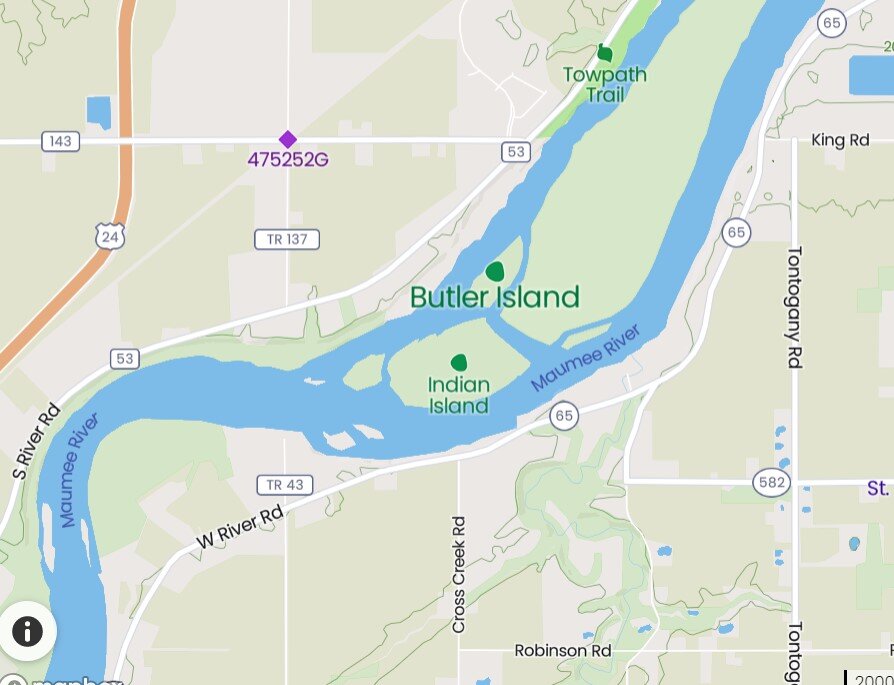
We wrote a few weeks ago about Missionary Island as the “Big Island” in the Maumee River at Waterville. Most of us are aware of the complex of smaller islands on the upriver end of our big island, separated by narrow channels. These were probably all part of one island long ago, but have been separated by erosion over many years. Our subject is Butler Island, the smaller island closest to the northwestern shore along old route 24. This island has a unique modern history.

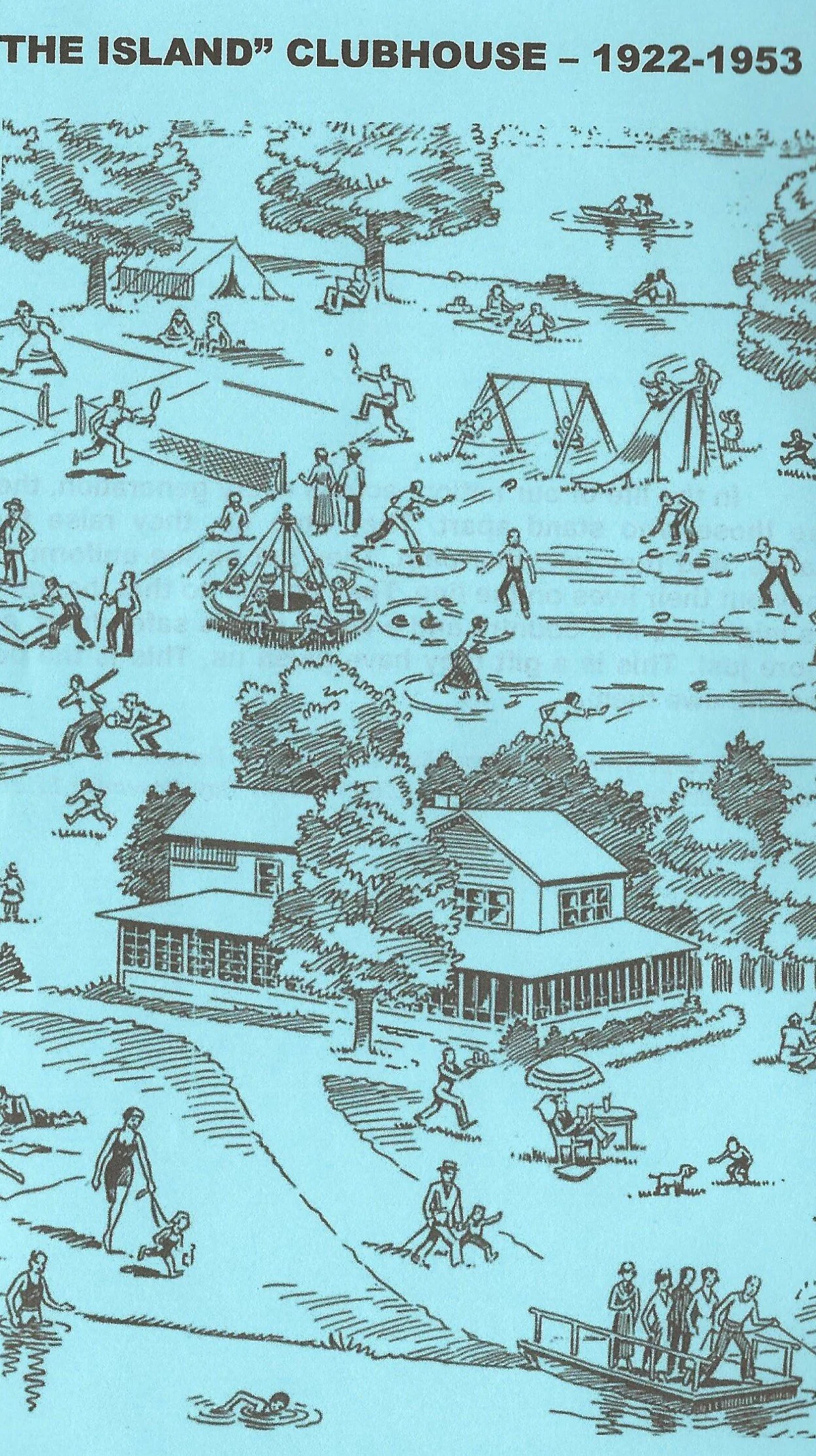
A small group of Toledo W.W. I. veterans in 1920 formed an American Legion Post which they uniquely named The Toledo Post 335. This post grew rapidly and became perhaps the most active and popular Toledo Legion group. They sponsored a Boy Scout troop and ball teams, held dances, stag parties and many social events, with membership in the hundreds. Early in 1922 this group decided to buy Butler Island, just 225 yards off shore near Waterville, and build an island retreat as a center for social activities. The island cost them $3500 and they soon built a two story clubhouse, tennis courts, ball diamonds, horseshoe pits, shuffle board court and children’s playgrounds. Work started on their recreational paradise in the summer of 1922 about the same time Chauncy Parker was doing the same on his “big island” as a commercial enterprise. Access to the island was by cable ferry although we have a photo that appears to show a short bridge over the channel between Parker’s big island and the Legion’s island in the 1920s. Unlike Mr. Parker, however the Toledo Post 335 persisted through the Great Depression by hosting a number of fund-raising activities and the facility continued to provide much needed recreation for Post 335 families through the difficult time. The island was mostly closed during the WW II years, but became popular again in the late 1940s as the post 335 ranks were increased with returning WW II veterans. The Island facility was aging however, requiring much work and money. The Post decided they would rent it out to company groups for picnics or social activities. In 1948 a cable ferry load of Textileather Company picnickers overturned and three persons were drowned. The old clubhouse was abandoned in 1953 when a new one was built on the shore, and finally razed in 1960. In 1969 the island was sold to the State of Ohio for $45,000 and nature again took over.

map of Butler Island.jpg

The island had been re-named Galbraith Island by the Legionnaires in 1923, in honor of Frederick W. Galbraith, a Legion Commander who had been recently killed in an auto accident, but was referred to by many of the members simply as “The Island” and often by the Waterville locals as “Legion Island”. The state seems to use the original Butler Island on their maps.

Ed. Note: the Archives has little information on the “Legion Island.” If any of our readers have photos, brochures, fliers or news clippings about activities on the island to share we would be most appreciative. Where on the mainland did they built their new clubhouse? Information is from “Old Soldiers Never Die…” by the Toledo Post 335 The American Legion, A Brief History 1920-2013 by Post Historian, Jack K. Paquette, Post Historian

Government Overreach No Stranger to Waterville ---The Swing Bowl Story

Mary Black and Opel Witte

Even well-intended laws are sometimes misconstrued or narrowly interpreted by overzealous government officials. Such was the case in Waterville May of 1944 and led one young Waterville man to write a letter to the President of the United States. As noted in the article below, the Witte Hardware Store was unable to obtain many hardware items during W.W. II so they converted half of their floor space to a soda and lunch counter, catering especially to teen-age kids. They installed a juke box so the kids would have music to dance to. They called their establishment “The Swing Bowl” and it was a very popular hang-out for the young crowd as well as an uptown lunch counter for Watervillians, known for soup, sandwiches and of course pie.

Wars are very expensive so in 1944 the government passed a 30% cabaret tax. This was supposed to be a “sin tax” on establishments where drinking, partying and dancing were done. April 1st of 1944, however, the local tax officials ruled that the Witte’s Swing Bowl was a “cabaret” and must charge the extra 30% tax even though no alcohol was ever served. The Wittes had to shut down their jukebox and put up a “no dancing” sign if they were continue in business. The kids were disappointed and angry of course which prompted one young man, sixteen year old Louis Augustine, a Waterville High School student, to write a letter of complaint to President Franklin D. Roosevelt. He pointed out that the “Swing Bowl was the village’s main source of entertainment for teens on nights that are as dull as only nights in a small town can be. Nothing in our record indicates that the letter did anything to resolve the issue. Mr. and Mrs. Witte decided to close the “cabaret” that they had run for four years already later that summer. The issue apparently was eventually resolved because Harry Witte sold the Swing Bowl and the hardware business in 1945 and this popular teen hangout continued in business for another four or five years. Some of our readers undoubtedly have some fond memories of this establishment.

For those that don’t remember the Swing Bowl, here is a little history of the place: Harry and Opel Witte owned the Waterville Hardware and Supply Company at 30 North Third Street for about 40 years. It was a large two-story building built in 1880 that burned down in 1955. The main floor was a large open room. During World War II the heavy implements the Wittes had sold there were converted to the war effort and unavailable. Opel had an idea to put in a partition and have a place to sell ice cream and have music that kids could dance to. "Swing" was the type of dance popular at the time so Opel named it the "Swing Bowl." In a 1987 interview she said, "It was like a little hangout for kids and it was fun for them. Friday nights and Saturday nights it was crowded." It became popular with all ages because hot dogs, hamburgers, sandwiches, homemade noodle soup and pies were also offered. Note the signs in the photo advertising sundaes for 15 cents and sodas for 12 cents!


THE BIG ISLAND

Photo by Art Weber courtesy of National Center for Photography as seen in The Mirror 10/4/2012

No, not Hawaii! OUR big island in the Maumee River at Waterville which at 246 acres is the largest island in the entire river valley. It seems that we don’t know what to call it since it has gone by a number of different names through our recorded history. We don’t even know what the Indians called it and they were there long before the French and English arrived. The early travelers simply called it the “Main Island” which is our first recorded name. In the 1760s the Ottawa Chief Pontiac established towns along this part of the valley including on the island. General Anthony Wayne’s legion decimated all of these towns in their 1794 march down and back up the valley. The Treaty of Greenville placed the island within the twelve mile square reserve (centered at Fort Meigs) but it was re-occupied by the Ottawa Indians, as were many locations up and down the river. The local natives were now more settled into towns or villages, usually known by the name of the chief, where they farmed and hunted in the surrounding forests and fished in the river. The town on the island in the 1820s and 1830s was called “Nawash Town” and the Neowash Road which runs straight to the island in the river is an English aberration of that name.

The Western Presbyterian Missionary Society of Pennsylvania in 1822 purchased the island and 372 acres of land in Wood County southeast of the river and established a mission to educate and Christianize these local village people. The large building they built on the banks of the river next to the island was called the Indian Missionary Station which led to the various names given to the island. (Along Route 65 about 2 miles past the ghost town of Miltonville is a marker put there by the Ohio Revolutionary Memorial Trail. In 2023 it is now found at the Otsego Park, a Wood County Park on Route 65 about 2-3 miles up river from where it was originally) It was then (and to this day) known as Missionary Island, but also Station Island or Mission Island. The mission run by the Rev. Isaac Van Tassel and his wife Lucia, operated for only twelve years as the Indians were removed to Kansas in the mid to late 1830s. Missionary Island was sold to various settlers who farmed the rich bottomland by transporting their horses and machinery to the island by barge.

In early 1900s the island was owned by a Parker family and primarily Ross Chauncy Parker who developed the island into a summer resort with waterfront lots around the outside and recreation such as golf, tennis, horseback riding, etc. in the interior. Many Watervillians remember picnics on the Island and the great terrazzo dance floor at the downriver end. A pontoon bridge was built from the Waterville side to the Island. The Parkers chose to call it Indianola Island but folks also called it Parker’s Island. The depression era of the 1930s put an end to Parker’s plans and he went bankrupt, as did many other businesses. The island was returned to farming until purchased by the State of Ohio in 1969 and allowed to return to nature. Today it is Missionary Island although frequently also Indianola Island --- so we are still confused.

A Christmas Message

We wish to extend our best wishes for a joyful holiday season to all of our readers. This year will be noted in history as the “year of the pandemic” yet we are determined to find the joy in Christmas. I think of our pioneer ancestors and the founders of our village. It was in the beginning, a hard hand to mouth existence. A Christmas tree at that time was an unknown custom and gifts, if available at all, were handmade or perhaps fruit or nuts. And yet they still found joy in Christmas. Our German forbears brought the custom of a decorated tree and our later 1800s Watervillians found much more opportunity as the village prospered. Today most families find joy in decorating a Christmas tree as well as much of the house, and in presents under the tree. Perhaps too much glitz, glamor and commercialism, but even so the joy of Christmas continues on through the history. And as we emerge from the cloud of this pandemic in our new year, may you all find some sunshine of things being normal again.

We at the Historical Society hope later this New Year to present in person programs again for the public, to open our museums and to welcome visitors to the Archives for research or just for the love of history. So please keep tuned! We also need your support to even exist so please join and/or donate. Thanks so much to readers and supporters. You can join through the website at www.watervillehistory.org .Then just click on “join and give.”

A Granddaughter Remembers by Katherine Heintschel

Katherine Heintschel

              My first memory of my granddad was riding on his shoulders.  His bald head was below my chin, his denim jacket warm beneath my bare legs.  Tall and long-legged, he more loped than walked.  A knee injury gave him a slight hitch in his gait but he was strong and energetic, vital enough at 72 to piggy back a two-year-old child.  I was eye-level with his cherry tree.

              When I was very small, I played in Granddad’s backyard more than my own because the Maumee River was dangerous to a child.  His back yard was bordered on the south by a Concord grape arbor, bordered on the other side by a long low building, painted white, that used to be a chicken coop.  Granddad converted it to a woodworking shop.  There was a mysterious gray shed, a bird bath that was chiseled out of a huge stone, and tall pine trees.  And of course the cherry tree. It was the last of the orchard that grew on his property before he sold the land for houses, including my parents’ house, along the Maumee River. 

              The cherry tree in Granddad’s yard spread branches for climbing, offered shade, and was home to a swing.  Lush and fragrant blossoms, white like snow, lay heavily on it in the spring.  That cherry tree held my family’s best stories.  Though it is gone now, I know the joyful time of this maybe one-time ride.  When I got older, I read in its shade, or climbed to a comfortable nook in it dark-barked branches to read.  A perfect swing, with a dusty scuff from feet beneath it, offered unlimited solace and entertainment.

              Because Granddad chose his property in Waterville on the river, because he built my parents, my sister, and me a modest Cape Cod house across the small dead end street from his back yard, because I loved playing outside, Granddad provided me the roots to grow.  Of course my parents raised me, and loved the river, too.  But I view life on the Maumee River as Granddad’s legacy.

              The very best time to live on the river was the winter. The river was shallow at the end of our property, and if the weather was just right, the ice would freeze smooth and clear.  My dad, retired Air Corp Captain that he was, used his survival skills and checked the ice. Once given the all clear, we took turns helping to move snow away from the best spots. The whole neighborhood joined together.  We laced up or clipped on our skates and skated on the Maumee River.  As a tiny child, I wore two-bladed, probably aluminum, skates on my feet.  The form for me was more of a shuffle, but the older ones glided in circles, held hands and waltzed, or played hockey.  The ice wasn’t checked for miles, might not have been safe, but if it were, one could skate far down the river. 

              Sometimes the river would flood early in the winter season, and when it receded, it left long pools of water that then froze into wonderful skating arenas.  As I was older, on these days, I would race home from school, throw my books down, change my clothes, and race to the skating ponds.  On these ponds, I could skate safely for miles.  And I did.  There was nothing like gliding in the cold, listening to the winter.  Often I was alone and allowed to skate by myself.  Sometimes friends would come, but I didn’t need them.  Now, folks would consider skating on the river, or even on these long ponds, unsafe, and indeed it can be.  There were stories of drownings, but my sister and I were taught to respect the river, and we were never unsafe.  A man-made rink in a neighborhood back yard is simply not the same.  That is a legacy my granddad, Howard Good, gave to me.


Who was Howard Good?

Howard Good

Several of our recent articles have mentioned Howard Good and the large collection of his artifacts and memorabilia donated to the W.H.S. Archives. Howard died in 1967 so some of our readers may remember, but let me fill in some details. Howard was born in 1885 and grew up on a farm in the Black Swamp region of Van Wert County. A bright and curious young man in that period in our history when we transitioned from the horse and wagon era to the mechanical age. Howard put himself through engineering school at Ohio Northern University, graduating in 1915. He married Grace Clay in 1914 and after spending a few years in Washington, D.C. as an editor of the “The Pathfinder” magazine the young couple moved to Waterville in 1919. Later in 1925 Howard took a mechanical engineering job at the Kerscher Elevator Co. in Toledo. Why Waterville? It seems that his Uncle Franklin Hook was the minister of the Waterville M.E. Church from 1904 to 1906 and Howard had visited here often. Both came to love this village and Franklin Hook moved back to Waterville in the late 1920s and served as mayor from 1932-1935.

Howard was a man of many talents. He became interested in photography as a young man. His first camera was a wooden bellows type that took pictures on light sensitized glass plates that had to be developed in a home darkroom. Roll film and commercial developing and printing would come later. It was a life-long obsession and the Wakeman Archives now has a collection of Howard Good photographs, some capturing life in Waterville from late 1920s through the 1960s. He was also active in civic affairs, serving on the Waterville council in the late 1920s and 1930s and for six years, using his engineering skills, as chairman of the planning commission in the 1930s and 1940s. While serving on the planning commission he drew a number of maps of the village showing streets, zoning and utilities, many of which are now preserved in the Wakeman Archives. He also created a new subdivision called River Terrance on property he owned north of the village along the Maumee River. His daughter, Marian, and her husband Wilson Morris built their riverfront home there.  Howard drew up the plans for the house and also created building plans for a new fire station for the village at 4th Street and Farnsworth (not built) and for a Whitehouse municipal building, again donating his talents and skill. Not surprisingly as an engineer, Howard was something of an inventor and applied for patents on some of the “gadgets” from his fertile brain. He also was a writer, contributing to the Toledo Blade and several magazines and journals, especially in his retirement years after 1948. His wife, Grace also served as the Waterville editor of the Standard newspaper and as a reporter for the Toledo Blade and Sunday times. His most ambitious retirement work was to write a book about the Black Swamp farm where he grew up. This work was hand typed through many revisions by his daughter Marian Morris who lived nearby. The book was finally complete and was published by Ohio State University Press just a month after his death in 1967. Howard and Grace are buried in Wakeman Cemetery

P.O. Box 263,  Waterville, OH  43566            watervillehistory@outlook.com

Site by T3m ltd.    All images are intended for research use only.  Please respect any limitations of their original copyright holders.